Category: Osmosis

  • Westerly Conway Osmosis Treatment, followed by application of Copper Coat

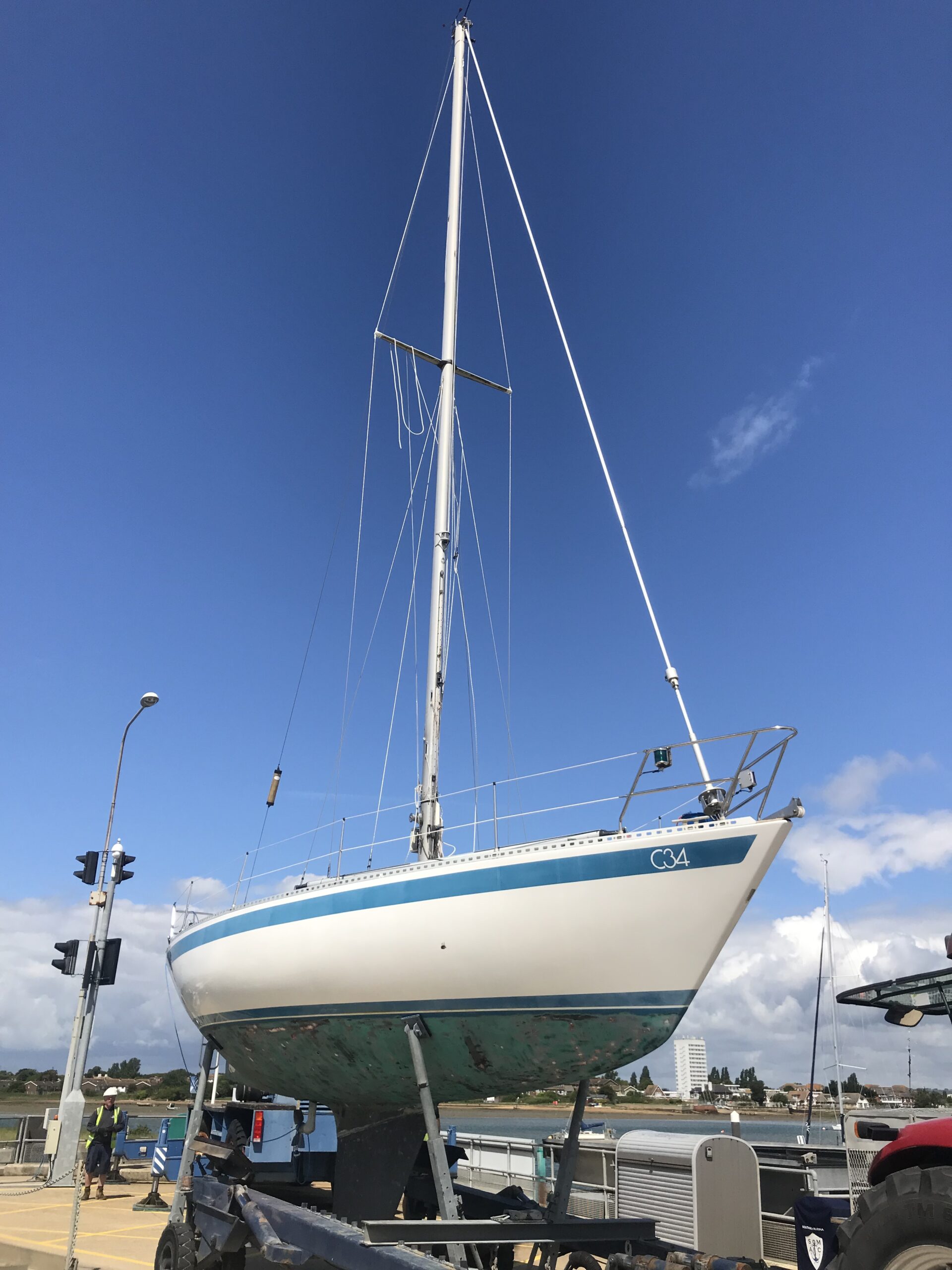
    Came to JWS late 2012, with Osmosis in the hull from the offset we know this wasn’t going to be a straight forward treatment.
    First hurdle was making the decision whether to machine or hand peel her, in the end a combination of the two was carried out.
    We generally tent up the hull mainly to protect the blasted hull, before proceeding to the hot-vac treatment, however with this project we tented her then left her with inferred heaters on localized seeping areas while tented for 7 week in total to try and draw the moisture from her hull.
    While in the care of JWS the owner opted for some other items of work to be undertaken, such as the application of Copper Coat, new headlining in the saloon, and varnishing of the floor boards new treadmaster paint applied to the deck and also the replacement of all seacocks with TruDesign
    The following images show the Osmosis treatment.
    1-3 – Hull before work has started
    4-7 Hull peeled
    8-9 Blasted
    10-12 Inferred on seeping areas
    13-15 Hot-vac treatment
    16-18 Application of the extra layers
    19-23 Osmosis Epoxy coatings
    24-26 Copper Coat applied

    There was water seeping throughthe hull from the keel bolts.
    To repair this we grinded back the area on both Port and Starboard side to allow the water to be released.
    2 infered heaters where put on both areas and allowed to dry over 1 week.
    The area was then cleaned and prepped for re-lamination back to the orginal thickness.

    Once this was completed we moved on the applying the stifferning layers in varioes areas of hull using 450csm and 600csm.

    Next step was to bring her into the shed for the hot vac treatment, in most cases we would only have to carryout 1 course of Hot-vac treament in this instance due to the high moisture content trapped in the hull we had to carryout 2 rounds of the hot-vac treatment.

    It was agreed to add an additional later of matting to to the hull, this was done using 3 layers of 450 CSm and 2 layers of 600csm.

    Now that the layers have curred we carried on with the application of AMC-100 Epoxy coatings.
    We applied 1 layer, the hull was then fill and faired off before appliying the further 4 coats.

    The treatment was completed and we finished with an application of Copper Coat.

    Please click on the link to see the other work carried our during her stay –

    Westerly Conway – Refurbishment of internal floors, headlining and Treadcote

    Gallery

  • Osmosis Treatment & Copper Coat application on a C34 Sweden yacht

    Osmosis Treatment & Copper Coat application on a C34 Sweden yacht

    Came to JWS in 2019, Following some moisture readings it was found to have Osmosis and was in need of a full treatment. treatment,
    The owner accepted and we prepped her for the first job was to Gel peel the hull using a peeler.
    We then blasted hull to open up the hull fibers and freeing the contaminates from the matting, this aids in the drying process.

    At this point we removed all below the water line through hulls, unfortunately in this project none of the ball valves were serviceable so we supplied all new parts for 5 through hulls.
    The new thru hulls were fitted and the ares cleaned.

    We also removed the rudder, to access behind and cleaned ready for the same application as the hull.

    After blasting she is hot washed 10 times over 14 days to aid in the drying process.
    Once dry she was moved into the workshop ready for the hot-vac treatment.
    In most Osmosis treatments only 1 course of hotvac is required, however due to the high level of moisture being retained in the hull, an additional 3 courses of hot vac were needed.
    After hot vac treatment the whole hull was sanded and then 1 coat of Jotuns Epoxy megacote is applied.
    The hull is filled and faired, then the following 5 coats of Megacote is applied.

    Due to the severity of the osmosis and the amount of materials removed during peeling etc we applied an additional layer of 292 tapered cloth, this was applied using Ampreg 30 resin and peel ply cloth before the Epoxy Megacote was applied.

    After the additional layer was applied and the Osmosis prevention epoxy applied and cured.
    The boat is lifted so that the hull patches (Left from cradle) are sanded.
    Finally the keel was coated with 5 coats of Epoxy.
    It was time for some anti-foul, the owner opted for a Copper Coat application, please see this application below.

    Gallery

  • Osmosis Treatment on a Westerly Discuss 33

    This boat came to us in 2018 for Osmosis Treatment followed by hull reinforcement
    While with us she also had her thru hulls replaced and her rudder split, cleaned and re-bonded.

    Normal procedure to start with a hull peel, however due to the high moisture levels a 2nd peel was required.
    This was followed by a hull blast.
    The hull was hot washed 10 time then she was moved into the shed for tenting up.
    Next was the hot vac hull cure treatment, generally only 1 course is required but with this Discuss her moisture content was so high she needed 4 courses.

    As she has a second peel and quite a lot of mat had to be removed to aid drying, we applied additional hull reinforcement on both the Port and Starboard side.
    14 patches were agreed by the surveyor for reinforcement and comprised of 1 layer of 450 csm powder and the 2 layers of 600 csm bound matting with a tapered area of 25mm on all layers and between the keels will be 4 layers of 450 csm.
    The hull was given a sand in preparation for the Epoxy bonding coat.
    The hull was filled and fared before applying the further 4 Epoxy Osmosis coatings.

    We finished the application with conventional Primer and Anti-foul.

    During the Osmosis treatment both keels were blasted and 5 coats of Corro-tech epoxy were applied and new keel seams were done.

    We also serviced and replaced the thru hulls on board

    While in the shed receiving her osmosis treatment we also carried out some work to her rudder, before we could start the steering gear had to be removed.
    With the yards assistance we lifted the boat to remove the rudder, upon removal of the rudder all bearing and seals were checked, this discuss needed a new upper and lower bearing set and a new lip seal, all of which we supplied and fitted.

    All the old coating was sanded form the rudder and taken back to good glass, all blisters were removed form the laminate by grinding, and ground holes were filled with 830 epoxy filler and sanded fair.
    The rudder was split in half and all foam from inside removed this allowed us to check the tangs and bonding.
    The inside was grinded and prepped for the re-joining of the rudder sides.
    Both sides were bonded together using a hi-strength gravicol bonding paste which was allows to cure and then this was laminated with 3 layers of 280 woven cloth and epoxy resin.
    It was then filled and fared with 830 epoxy filler and sanded fare.
    The rudder was then epoxied to the same spec as the hull, primed and antifouled.

    Gallery