

What is osmosis?
Osmosis happens when water gets through the gel coat and reacts with the binders that hold the glass matting together, or with uncured resin left over from moulding. The reaction forms larger, often acidic molecules that can’t pass back out through the GRP. They stay trapped and push the gel coat up into blisters, which release a vinegary fluid when popped.


Full osmosis treatment with Hot-Vac hull cure
Treating osmosis on older boats is complex. We let boats stand for at least two weeks so the hull dries out and moisture readings are accurate. Accurate, regular readings matter: epoxy is a waterproof membrane that keeps moisture out but also traps it in, and trapped moisture can speed up osmosis by up to 50%.
Watch our osmosis treatment video, or see the step-by-step process below.
1. Hull gel peel
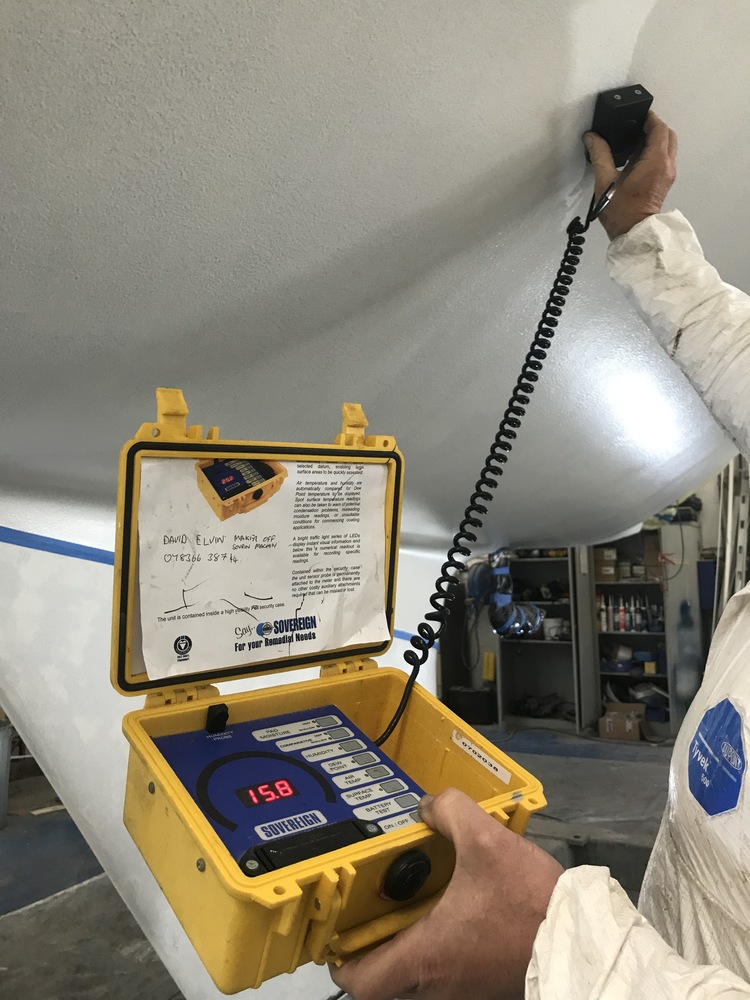
We remove the gel coat in sections, by peeling machine or by hand, so the fibreglass is exposed and can dry out. We then take moisture readings with a Sovereign moisture meter. If moisture is above 10%, further peeling may be needed.


2. Hull and keel blast
We blast the hull, and the keel(s) if required, to expose existing blisters and any that are starting to form.

3. Corro-tech on the keel(s)
If the keels were blasted, we apply five coats of Corro-tech and remake the keel-to-hull joint.

4. Hot wash the hull
Hot washing speeds up drying. As a guide we wash the hull 10 times over 14 days, and more if needed. Watch our hot washing video.
5. Tent the hull and Hot-Vac
The Hot-Vac system uses four large pads placed on the hull, which apply controlled heat and vacuum. This draws out water along with the compounds that cause corrosion, weaken the glass and resin bond, and lead to delamination and blistering.

6. Sand and first epoxy coat
We sand the hull to an even surface, tape it up and apply the first coat of osmosis epoxy.

7. Five further epoxy coats
We fill and fair the hull between coats, then apply the remaining five coats of osmosis epoxy.


8. Antifoul or Coppercoat
We can finish with a Coppercoat application, as shown here, or with conventional antifoul if you prefer.


Optional extras
- Extra layer(s) of 292 tapered cloth
- Surveyor oversight, with three visits: moisture readings after the initial peel, moisture readings before application, and a final inspection with a written report
We work with a number of surveyors, but we’re happy to use your own if you have a preference.
Approved osmosis treatment centre
Almost every unprotected glass fibre boat will show some osmosis at some point in its life. JWS Marine Services is an approved International osmosis treatment centre, and we’re experienced with products including International Gelshield Plus, AMC ME100 epoxy coating and Jotun Megacote, so we can choose the best solution for each boat.
Osmosis prevention
Prevention should start when you buy a new boat. Up to three coats of epoxy can be applied to a new hull, ideally before she first goes in the water. More and more new boats now launch without this protection. For a professional protective finish we recommend:
- Blast the hull and keel
- Sand and spot fill the hull
- Five coats of Corro-tech epoxy on the keel
- Two fills of epoxy filler on the keel, then sand
- A new keel joint
- Three coats of epoxy primer on the hull
- Two coats of antifoul
Our osmosis projects
- Westerly Conway: Coppercoat after osmosis treatment
- Sweden Yacht C34: osmosis treatment and Coppercoat
- Osmosis treatment on a Westerly Discus 33
- Osmosis prevention and Coppercoat on a Wessex 390
- Osmosis treatment on a Twister 28
Get a quote
Tell us about your boat and what needs doing. Call 02392 755 155, mobile 07803 616229, email info@jwsmarineservices.co.uk, or use our contact form. Photos help us give you an accurate estimate.
Gallery


